Zoom In: Ecology
Of all the important questions that occupy human minds, one is eternal: how to survive? It's a question that can turn in an instant from a seemingly prosaic problem with a rational solution into a universal riddle to which no one knows the answer. We may engage in credible or more questionable conjecture about the demise of wonderful ancient civilisations; evidence of whose existence is revealed to us from time to time by the soil and cultural memory. But there is no answer to the question, just like there is no solution to the currently acute contradiction between the human desire to control and exploit natural systems and our negligible knowledge about them – no one can fully explain the workings of ecosystems or what determines biological diversity on Earth. Religious and philosophic teachings all have their own accounts, while the branch of science delegated to study the relationship between living organisms and the environment has acquired the name "ecology", from the Greek word οἶκος, oikos, meaning house or environment. Economics has the same root.
Ecology is a comparatively new science but the changing climate and the coronavirus pandemic in the early 2020s has given it extraordinarily powerful resonance among the public. In particular, the mass involvement of the younger generation in climate activist movements following the Swedish fifteen-year-old Greta Thunberg has made us re-evaluate our deep-rooted convictions and introduced a new perspective on man's place on Earth among other species. Within the last few years, at least in the West, people have noticeably started to change their habits – what we eat, what we wear, what we do with surplus production, how we travel, how we construct our identity and build our relationships with others; furthermore, this change in opinions and habits has been influenced by ever-present technologies and artificial intelligence's promise that it can do everything quicker and better than us. Paradoxically, it is young people's activism that, by rousing the masses and also setting off the sceptics, has brought the focus of the general public back to science and its potential to provide trustworthy results from observations, experiments and modelling of the future, on which cases in debates and decisions can be based. Furthermore, the attitude of scientists is also changing with regard to the role of emotions – seemingly the antithesis of science, for the benefit of the common cause: the preservation of life on the planet.
In order to change ingrained ways of thinking, it turns out that it is not enough to just have statistics, figures and graphs demonstrating the effect of human activity on the environment. Thus, the environmental philosopher Glenn Albrecht from Australia, for example, argues that society's ability to communicate with the world ought to be based on the skill of navigating "earth emotions" and that human intellect ought to copy the symbiotic, mutually supportive forms of existence found in natural systems, instead of continuing to see itself as the crown of creation. Emotion, as opposed to rationality, is commonly perceived as an instrument useful only for the arts. The production of empathy or affection or of different, contrary emotions is a characteristic that is specific to art, and art is even often defined as a means of communication necessary for the development of humanity by bringing people together through shared experience. Emotions do indeed possess a unifying and effective force, and so they should be studied and understood, as much as possible, by involving works of art in the relationship between the Earth and humans. Art makes it possible to more directly intuit the world and one's place within it.
While over the preceding half a century or so, the dominant view was that climate change only affected physical wellbeing – through the spread of diseases, air and water pollution, food shortages and so on – now in conversations dealing with climate health, we increasingly encounter such terms as eco-anxiety, Earth anger, eco-grief and solastalgia, among others. For example, solastalgia (from the Latin word solacium – comfort – and the Greek word αλγἶα – pain) is emotional or existential suffering caused by environmental change and the loss of familiar landscapes, which is comparable to the experience of forcibly having to leave home. Climate grief is related to what has already been lost or the feeling of powerlessness in observing what is disappearing in front of our eyes. Meanwhile, eco-anxiety involves an entire mix of emotions: fear, anger, despair, hopelessness, guilt and vicarious embarrassment, which causes constant stress and particularly heavily affects the mental health of children and young people. An escape is promised by a renewed connection with the natural world, a well-developed capacity for sensing nature, and love towards and identification with the Earth. For better or worse, this connection rarely emerges directly. Sometimes it does, as in the fantasies about merging with nature of artists weary of the 19th-century Industrial Revolution, but more often it happens through technological mediation, which enables us to take a closer look at the other inhabitants of the Earth, both microscopic and gigantic, static and mobile, visible and audible- or tangible-only, to communicate with them and even become embodied in them.
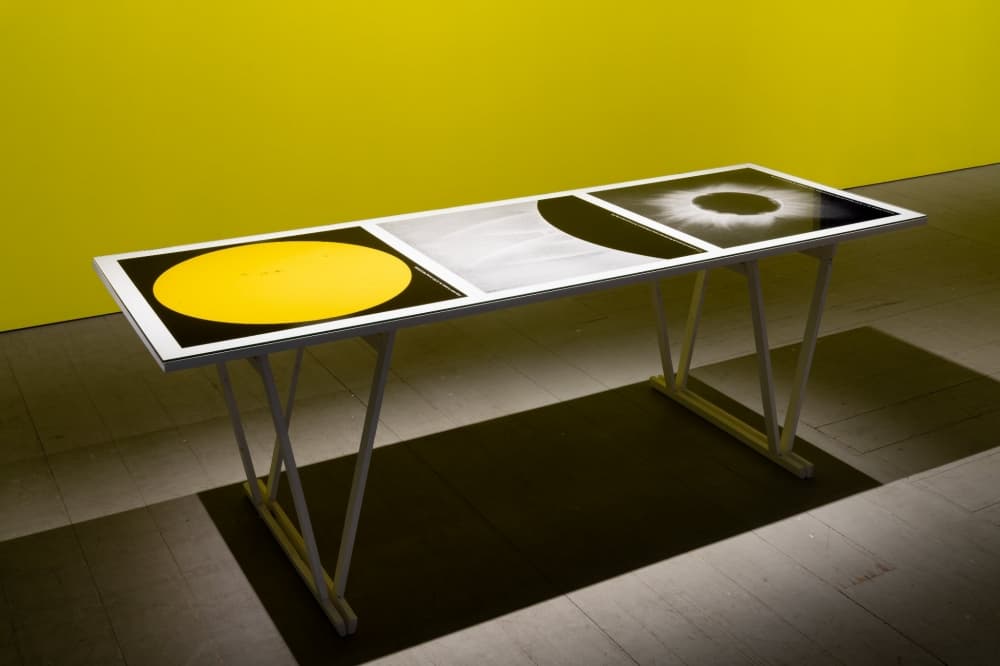
The exhibition Zoom In: Ecology presents nine reflections on human merging with digital technologies and/or nature. It investigates how digital activities influence ecosystems, natural resources and human nature, attempting to navigate through this finely crafted web of relationships.
Participants: Astrid Ardagh (NO), Nanna Debois Buhl (DK), Henna-Riikka Halonen (FI), Inka & Niclas (SE), Kristina Õllek & Kert Viiart-Õllek (EE), Rasa Šmite and Raitis Šmits (LV), Sabīne Šnē (LV), Istvan Virag (HU/NO)
Curators: Inga Brūvere (LV), Marie Sjøvold (NO)
Text by: Aiga Dzalbe (LV)
Exhibition design: Inga Brūvere (LV)
Exhibition page →Organiser: Rīgas Laikmetīgās mākslas telpa →
Address: Kungu iela 3, Rīga, LV-1050 →
Tue–Fri 12:00–19:00
Sat 11:00–19:00
Sun 11:00–17:00